
Summary
- McCormick is responsible for ~20% of total sales for the seasoning and spice industry.
- The company's most recent quarterly results were negatively impacted by currency exchange, but showed solid sales in constant currency.
- While McCormick's yield is low, its dividend history and consistent increases are very appealing.
- The stock's valuation makes me hesitate to add more at the moment.
- On a pullback, I'd happily add more to our position.
McCormick & Company (MKC) is one of my favorite consumer staples companies. It is estimated that McCormick controls 20% of the spice and seasoning market. This gives it pricing power with customers. The company’s purchase of RB Foods, whose products include Frank’s Red Hot and French’s mustard, has been well worth the $4.2 billion price tag.
Shares of McCormick are up almost 17% year-to-date, but nearly 60% since the start of 2018. This has caused the stock’s price-to-earnings multiple to become stretched.
McCormick is a core holding in the March to Freedom Fund, but I won’t add to the position at just any price.
This article will review McCormick’s most recent quarterly results, dividend history and valuation before making a decision on whether to purchase more shares of the company.
Recent Earnings Results
McCormick reported earnings results for the second quarter on 6/27/2019. The company earned $1.16 per share in the quarter, a 14% improvement from the previous year and $0.08 higher than expected. Revenue of $1.3 billion was flat from the prior year, though this was $10 million lower than expected.
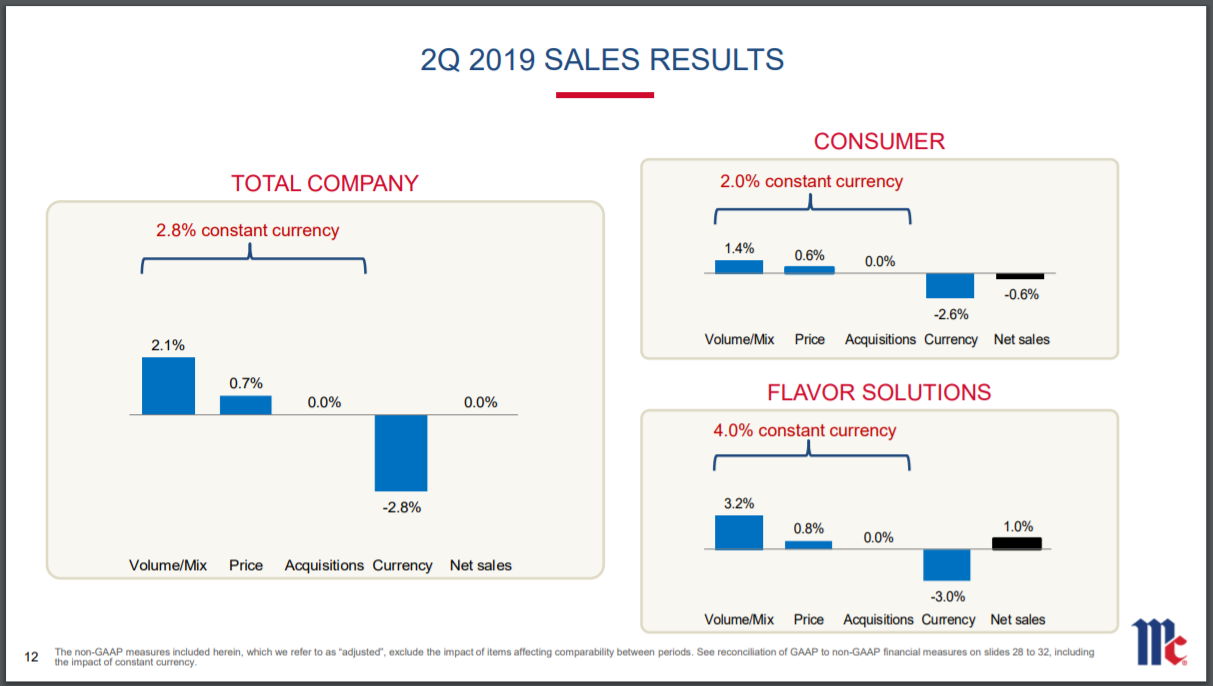
Source: McCormick & Company’s Second Quarter Earnings Results Presentation, slide 12.
Currency exchange negatively impacted revenue results by 2.8%. On a constant currency basis, revenues were higher by 2.8%.
Sales for the consumer division grew 2% in constant currency. This division contributes roughly two-thirds of total sales. Volumes/product mix contributed to the bulk of this growth as McCormick was able to expand distribution. New products also were a factor. Currency exchange reduced revenue for this division by 2.6%.
Growth in the consumer division was especially pronounced in the Americas region thanks to a 2.2% increase in volumes. Frank’s Red Hot and Zatarain’s were the primary contributors. The company was able to increase prices by 5.7% in the Asia/Pacific region, but this was more than offset by a 3.1% drop in volumes and a 6.3% reduction due to currency exchange.

